COMPUTER ENGINEERING @ SJSU · EXPECTED MAY 2028

Aaditya Desai

Software for real constraints.

I work across on-device ML, offline-first applications, and AI infrastructure, following each project from the model or protocol to the interface people use.

Seeking Summer 2027 software engineering, ML, and systems internships.

aaditya.d.desai@gmail.comJump to projects

UC Berkeley AI Hackathon
WinnerThe Token Company sponsor track
Accordion
200+GitHub stars on the team repository
GazeBoard
~8 msinference on a phone NPU

Selected Projects

PROJECT 01 · OPEN-SOURCE AI TOOLING

Accordion

See what your agent remembers.

THE PROJECT /Most coding agents handle a full context window by flattening the session into one lossy summary. Accordion makes the window visible and reversible: individual blocks can be folded, unfolded, pinned, or recalled while a protected recent window stays intact.

MY PART /On a team of three, I built the hackathon relevance pipeline with keyword scoring, bi-encoder retrieval, and cross-encoder reranking. I also built the live attribution view that shows whether a fold came from the user, agent, or conductor. In an early hackathon-scale SlopCodeBench run at a 100k-token budget, Accordion completed 5 of 6 checkpoints versus 2 of 6 for naive compaction. We won The Token Company sponsor track at UC Berkeley AI Hackathon 2026.

MY PART: PYTHON · HUGGINGFACE TRANSFORMERS · SVELTEKIT

the context map, live

PROJECT 02 · ANDROID · DAILY DRIVER

ApexTracker

One app instead of a pile of post-its.

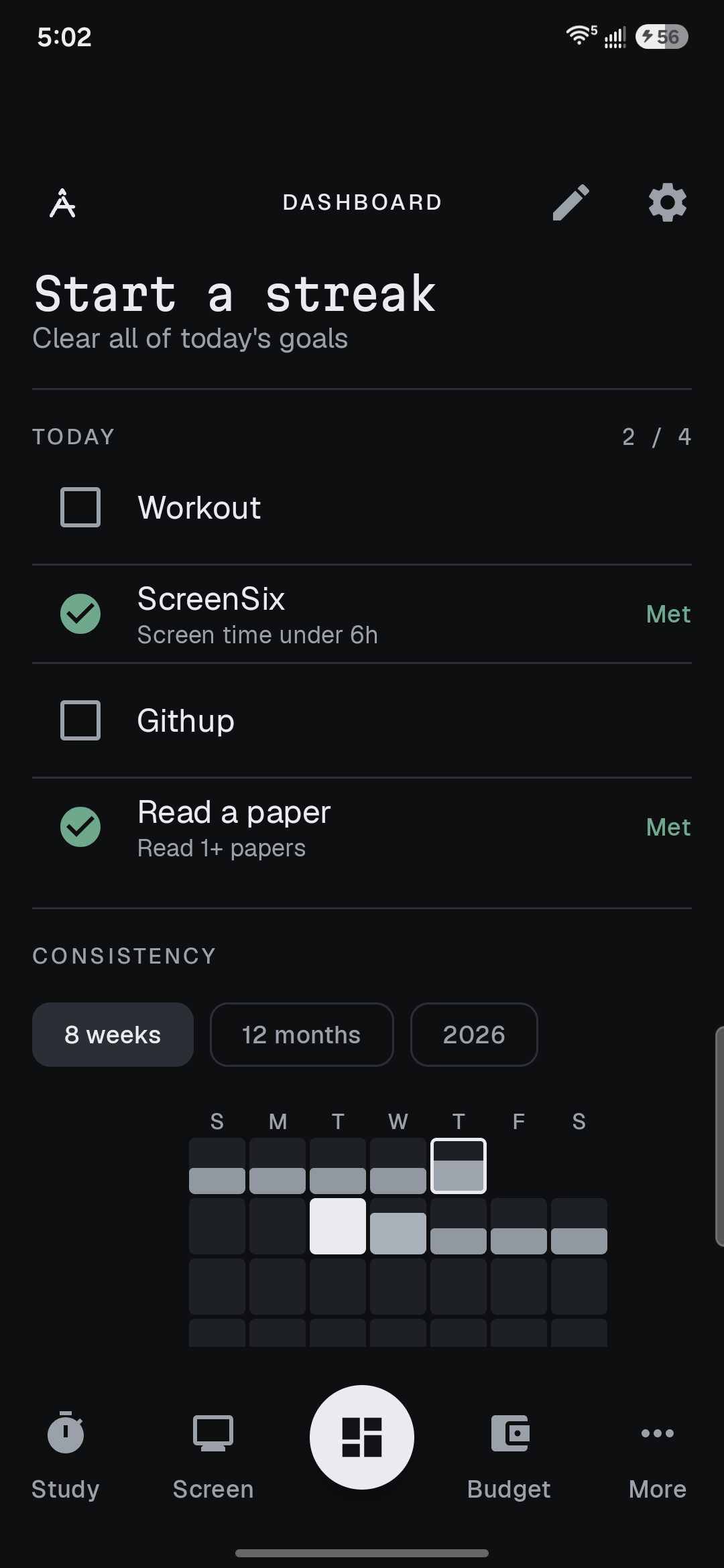
WHY IT EXISTS /ApexTracker is the one app I use instead of a pile of post-its, three reminder apps, a calendar, and a couple of spreadsheets. It tracks budget, study time, screen time, reminders, notes, and papers, then scores each day by the goals I actually hit. Everything works offline; an account is optional and only adds Firestore sync.

WHAT I BUILT /Room is the source of truth, encrypted with SQLCipher and gated by biometrics where needed. Reboot-safe alarms, five Glance widgets, on-device receipt parsing, handwritten schema migrations, JUnit tests, lint, and Compose screenshot tests make it a codebase I can keep using, not a demo I am afraid to update.

KOTLIN · JETPACK COMPOSE · ROOM · SQLCIPHER

  • DAILY DRIVER
  • LOCAL-FIRST
ApexTracker's graphite dashboard: daily goal score and a consistency bar chart in monochrome

the day, scored

PROJECT 03 · ON-DEVICE ML

GazeBoard

Typing with your eyes, entirely on-device.

THE PROJECT /A gaze-driven communication board for people who cannot reliably speak or use their hands. Because the camera stays pointed at the user's face, privacy was a requirement rather than a feature: frames stay on the phone and the app declares no network permission.

MY PART /I built the Kotlin pipeline from CameraX capture and ML Kit face detection through LiteRT inference on the Hexagon NPU, four-point affine calibration, dwell-based tile selection, and speech output. On the Galaxy S25 Ultra used during the hackathon, the pipeline measured roughly 8 ms per inference at 15+ FPS. Built with a team at the Qualcomm × Google LiteRT On-Device & Edge AI Hackathon.

KOTLIN · COMPOSE · CAMERAX · ML KIT · LITERT / HEXAGON NPU

  • ON-DEVICE
  • ~8 MS INFERENCE
  • ZERO NETWORK PERMISSIONS
  • APACHE-2.0
YESNOHELPWATER

▮ 4 gaze directions · dwell to type

dwell-based eye typing, drawn to scale

PROJECT 04 · OFFLINE SYSTEMS

Echo

Emergency alerts that survive the internet dying.

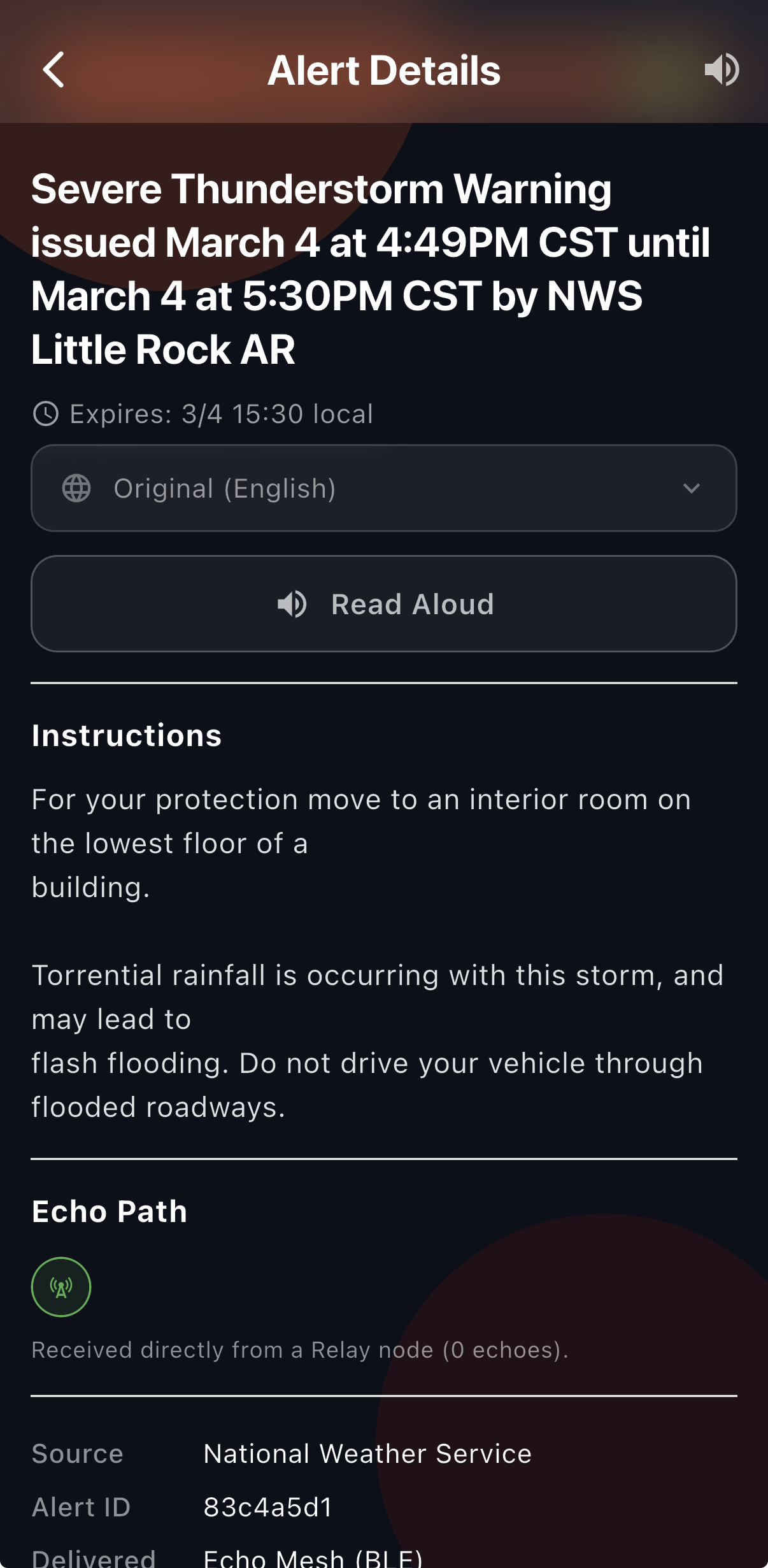
THE PROJECT /Echo is a prototype for carrying National Weather Service alerts between nearby devices when cellular and internet infrastructure are unavailable. It implements BLE discovery and a custom chunked GATT transfer path on Android and iOS, with optional Raspberry Pi relay utilities and compact alert IDs for deduplication.

MY PART /I built the native Kotlin and Swift protocol layers. Once received, an alert can be translated on-device into 22 target languages and read aloud. Built for Hack for Humanity at Santa Clara University.

FLUTTER · KOTLIN · SWIFT · BLE / GATT · SQLITE

  • OFFLINE MESH
  • 22 LANGUAGES
Echo showing a severe weather alert received over Bluetooth mesh, with translation controls

an alert that arrived with no internet

PROJECT 05 · AI EVALUATION

Temper

Test the system around the model.

THE PROJECT /AI agents are more than their base model. Prompts, tools, skills, and orchestration can help, or they can quietly make the same model worse. Temper compares an agent harness with a bare-model baseline across six dimensions, identifies harness-caused regressions, produces replacement artifacts, and reruns only the affected checks.

MY PART /I built the local evaluator, FastAPI service, schemas and contracts, patch loop, deterministic integration path, and streaming dashboard. Its strongest current evidence is a reproducible offline fixture that verifies the complete evaluate → patch → re-evaluate protocol; live-model evaluation remains prototype work. Built at the AI Engineer World's Fair Hackathon 2026.

PYTHON · FASTAPI · REACT · SSE · JSON SCHEMA

  • AI EVALS
  • HACKATHON BUILD
MODELbareMODEL+ harnessJUDGE6 dims
INSTRUCTION ADHERENCE-27PATCH
TOOL ACCURACY-41PATCH
OUTPUT FORMAT-03PASS
SKILL TRIGGER-08PATCH

the test bench, drawn

ALSO BUILT / CLEAR DISPATCH: a local emergency-dispatch simulation with a four-stage FastAPI pipeline, live WebSocket dashboard, Haversine unit assignment, and explicit dispatcher approval before heavy assets move · team project at HackDavis 2026

About

I keep gravitating toward software with an awkward constraint: no network, a fixed compute budget, a latency target, or an agent that has run out of context. Those projects force me to understand the whole path, from the model or protocol through the interface someone actually touches. They make hand-waving difficult.

ApexTracker is probably the clearest picture of how I build. It began as an intentionally ordinary tracker so I would write code every day; somewhere along the way, it replaced the post-its, reminder apps, and spreadsheets I was actually using. Teaching C++ and debugging to first-time programmers shaped the same habit: trace the symptom backward, explain the mechanism clearly, and stay with the problem until the abstraction stops hiding it.

  • BASED / SANTA CLARA, CA
  • STUDY / COMPUTER ENGINEERING @ SJSU · EXPECTED MAY 2028
  • LOOKING FOR / SUMMER 2027 SOFTWARE, ML, OR SYSTEMS INTERNSHIPS