Alta
A voice TA for the stuck student: it reads real voltages and walks them to the fault.
Cal Hacks 13.0 · 36 hours · Team of four: Aaditya Desai, Oak Soe Khant, Thy Tang, A Zin Kyaw · Oct 2026
Results
- 3 /
3Real-board runsfault found and fixed, 110 s to 322 s, no errors - 2.57 sTime to first speechmedian from releasing the talk button; transcript 0.55 s
- 42 /
42Simulated runs naming the right fault7 faults, 3 runs each, graded by a second model - 195Server testspytest
Alta highlights
- Nudge
- Question
- Point
- Fix
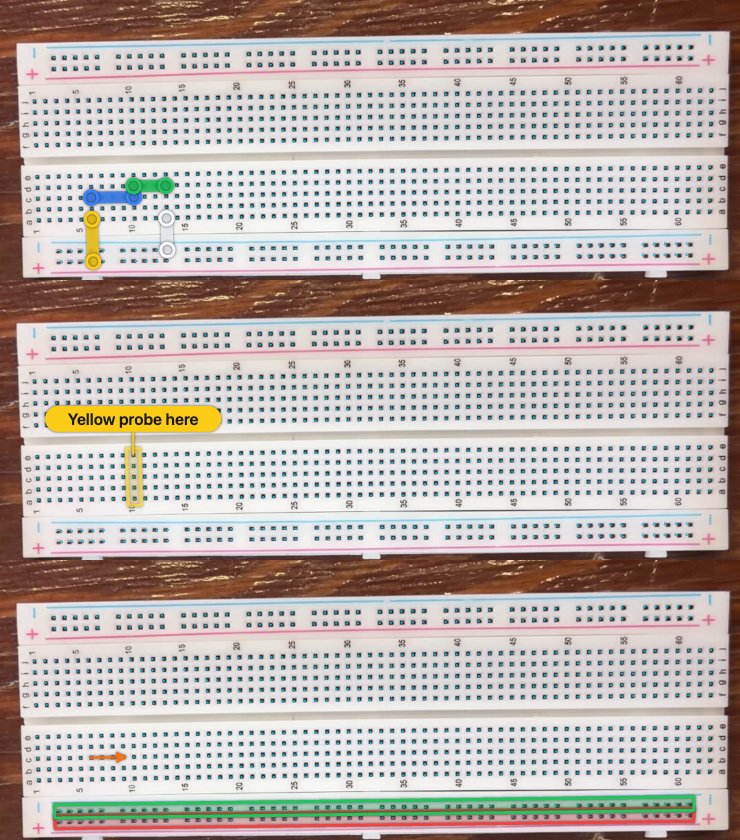
Let's find where the power stops. Put the yellow probe in row 15, where the resistor meets the LED. What do you expect it to read?
Transcript (2) & pod serial stream
StudentHi, my LED is not lighting up.
AltaLet's find where the power stops. Put the yellow probe in row 15, where the resistor meets the LED. What do you expect it to read?
Probe the row.
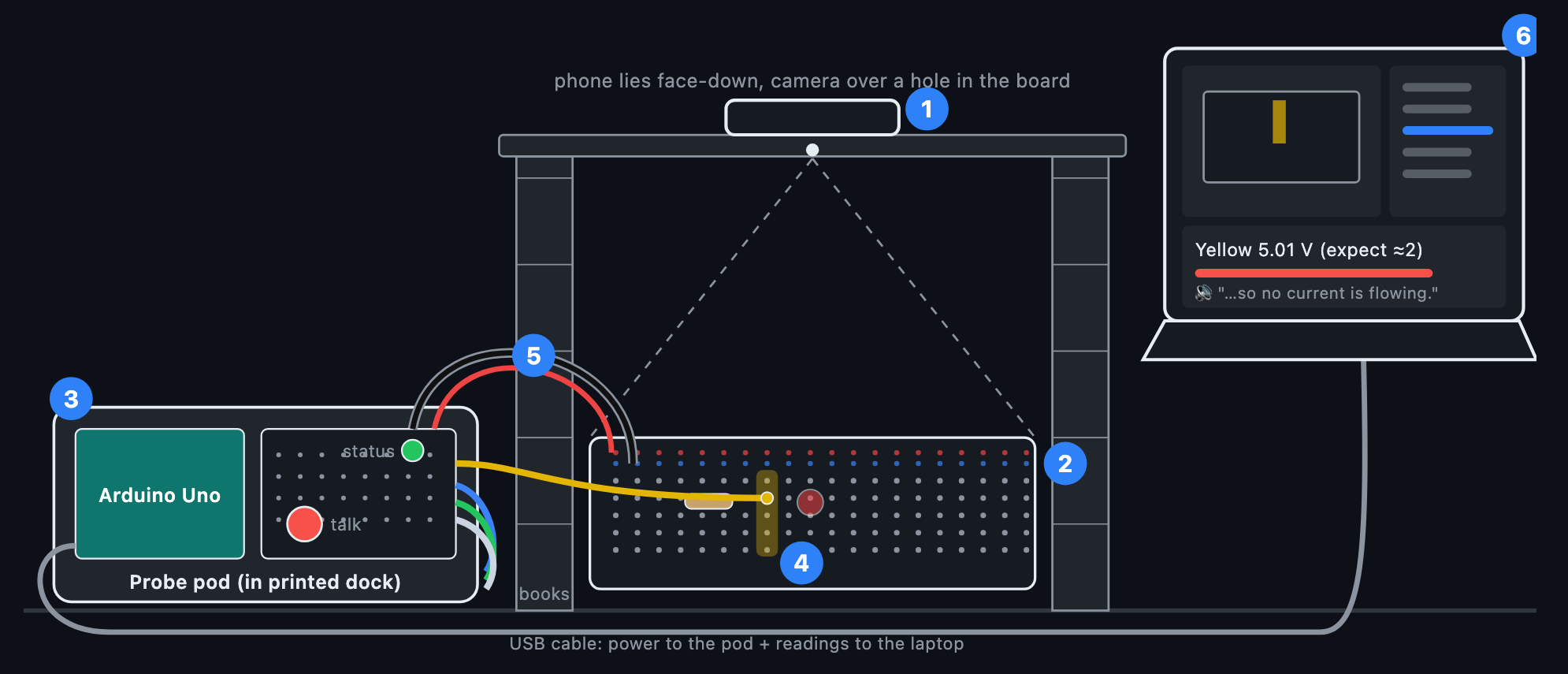
Alta asks the student to put a probe in a row. It doesn't guess from a photo; it reads the real voltage.
Sample fast, on the metal.
The probe pod is bare-metal C on an ATmega328P: interrupt-driven ADC, UART and timer, no Arduino libraries. About 1,200 reads a second per probe, with the supply voltage measured against the internal 1.1 V bandgap.
One line every 50 ms.
The pod streams a JSON line with mean, min and max per probe in millivolts, the supply voltage and the button state. make check runs the real firmware in simavr against the server's real serial bridge: 25 checks and a 60 s soak.
Teach, don't tell.
Alta talks the student toward the fault without handing over the answer, and the probe monitor confirms the fix on its own. On the real board it fixed all 3 of 3 timed faults, starting to speak a median 2.57 s after the talk button was released.
Why
In an intro electronics lab, one TA covers a room, and most students get stuck on the same few mistakes: an LED in backwards, a resistor with the wrong bands, a ground wire that never reached the rail. A student waits ten minutes for a TA who finds it in thirty seconds, often by fixing it for them. Alta is the TA already at the bench. A probe pod measures the student's breadboard, an AI agent talks with them by voice, and Alta teaches from a real voltage reading, with hints instead of the answer. It comes from my own work as a TA for ENGR 10 lab sections, and we built it in 36 hours at Cal Hacks 13.0.
What I built
I built the probe pod, hardware and bare-metal firmware, plus the lab definitions, the probe monitor and the camera overlay engine.
- Wrote the probe pod firmware in bare-metal C on the ATmega328P, no Arduino libraries: interrupt-driven ADC, UART and timer drivers. It samples each probe about 1,200 times a second and sends one JSON line every 50 ms.
- Tested the firmware in the simavr simulator against the server's real serial bridge: 25 checks plus a 60 s soak, button latency of about 19 ms, and a bouncy press giving exactly one down and one up.
- Built the probe monitor and the labs as data. When a reading holds steady for 500 ms or jumps into range, the agent speaks with no button press. Each lab is one lab.yaml of parts, holes, expected voltages and hint ladders.
- Built the camera overlay engine: corner calibration and a homography map camera pixels to breadboard holes, and it draws highlights and annotated frames, with tests.
Built with
C, avr-gcc, ATmega328P, simavr, Arduino Uno, Python, FastAPI, Claude Opus 5.5, Cartesia, React
From the build