VisionAssist
Tells someone walking without sight what is ahead, and how many steps away.
Infineon Technologies, with De Anza College · Software lead · Team of five, supervised by Prof. Saied Rafati · Apr to Jun 2026
Results
- ≈200 ms /
frameDetection latencyYOLOv8n, PyTorch CPU, about 5 FPS end to end - d = H·f /
hDistance model27 class heights, f = 900 px - 9 ft /
6 ftWarning zonescaution, then "stop" under 6 ft - 1Announcements per framehighest risk tier, then nearest
VisionAssist highlights
Detection details · d = H·f/h & ranking table
| Object | Tier | Est. distance | Zone |
|---|---|---|---|
| chair ◀ subject | High | 4.5 ft | Warning |
| person | Medium | 8.0 ft | Caution |
| dog | Medium | 12.0 ft | Safe |
| cup | Low | 5.0 ft | Warning |
YOLOv8n · ≈200 ms/frame · conf ≥ 0.45 · - - - true extent, off-frame. Rank by tier, then distance. 2.5 ft per step. Repeats only when the message changes or after a 3 s cooldown.
See.
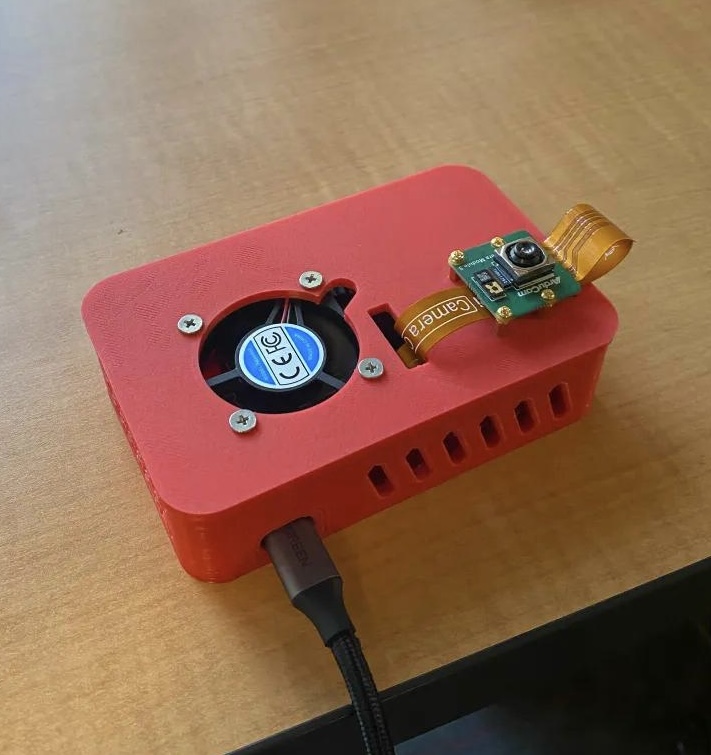
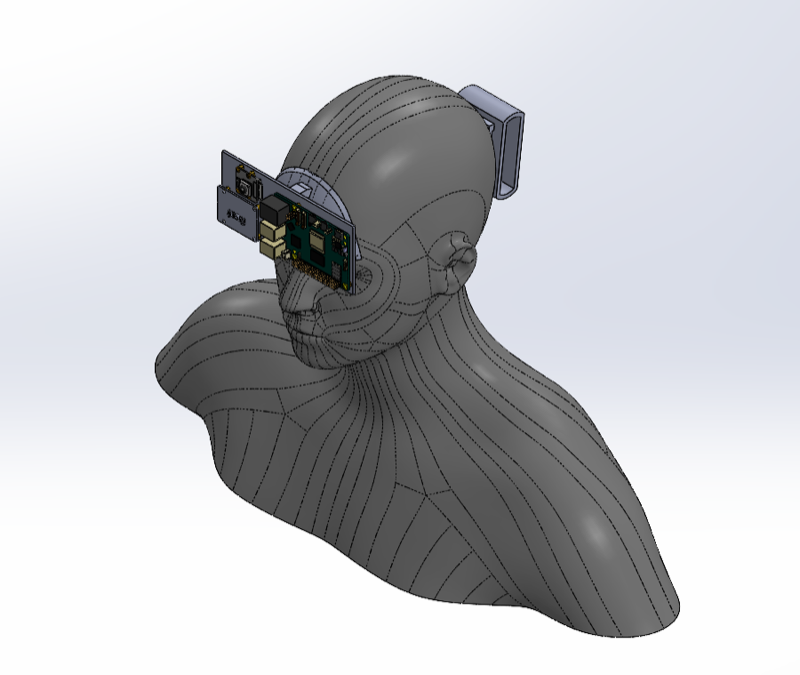
An Arducam on a head mount feeds 1280×720 frames to one Python process on the Raspberry Pi 5, about five frames a second. Nothing leaves the device.
Detect.
YOLOv8n runs on the Pi's CPU at about 200 ms per frame, with a 0.45 confidence floor and a blocklist for classes that don't matter on a sidewalk.
Measure.
Distance comes from box height: real height × focal length ÷ pixels. 27 hand-set class heights, focal length tuned from a theoretical 1435 px to 900 px. I rejected ground-plane projection because head tilt varies by about ±15°.
Choose one thing to say.
Objects are ranked by risk tier, then distance. Only the single riskiest, closest one is announced, in feet and steps, and only when it changes or after a 3 s cooldown.
Speak.
Piper TTS on-device, through Bluetooth earbuds, as a systemd service that boots headless. I evaluated Infineon's 60 GHz radar for weeks and sent the analysis to Infineon.
Why
A person walking down a sidewalk without sight can't wait for a network, and any round trip adds delay to a collision warning. So everything runs on a head-mounted Raspberry Pi 5: one process, one loop, about five frames a second, with no phone, cloud or internet. That requirement drove the model choice, the distance method, the speech engine, and the camera-only design I chose after evaluating Infineon's 60 GHz radar. It was built through De Anza's ENGR 77 with the Infineon University Alliance, and the finished device was demoed to the Infineon sponsors.
What I built
As software lead I owned the vision pipeline, distance estimation, audio output and the web layer.
- Built the whole on-device pipeline: camera capture, YOLOv8n at about 200 ms a frame on the Pi 5 CPU, monocular distance from bounding-box height, and risk-ranked speech in feet and steps (2.5 ft per step) to Bluetooth earbuds.
- Evaluated Infineon's 60 GHz radar on the PSoC 6 AI Kit, traced its close-range readings to antenna leakage and floor reflections, and delivered the write-up to Infineon.
- Deployed it as a headless systemd service that boots on power-up, with an annotated MJPEG stream and a phone web app as a second output path.
Built with
Python, PyTorch, YOLOv8, OpenCV, Picamera2, Flask, Piper TTS, systemd, Raspberry Pi 5
From the build