Results
- BLE GATTTransportindexed chunks, gzip
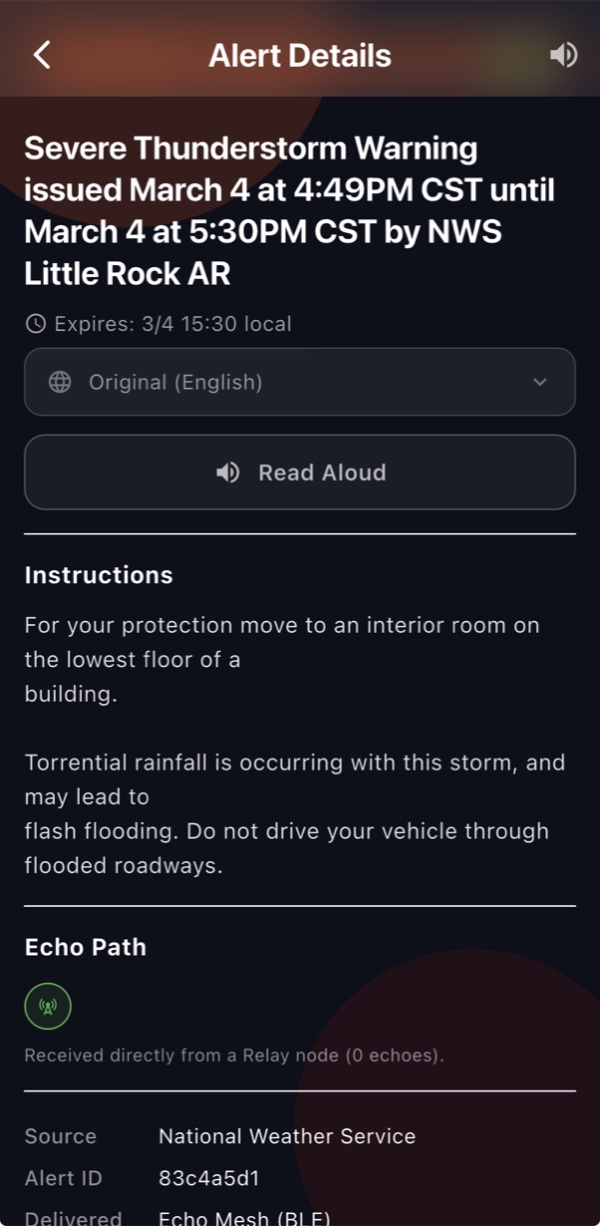
- 22 languagesTranslationon-device, plus text-to-speech
- 9 passingPi relay testsalert model, metadata packing, chunk framing
- noneInternet requiredafter the first device has the alert
Alert 7f3a · Severe Thunderstorm Warning6 chunks · 0 bytes over the internet
Click a phone on the map, or press Start
Tower down · 0 phones have the alert
Packet details · 2,431 B JSON → 1,014 B gzip → 6 chunks
alert JSON · 2,431 B→ gzip →1,014 B→c0c1c2c3c4c5
GATT: write a chunk index, read that chunk · ≈169 B each
Why
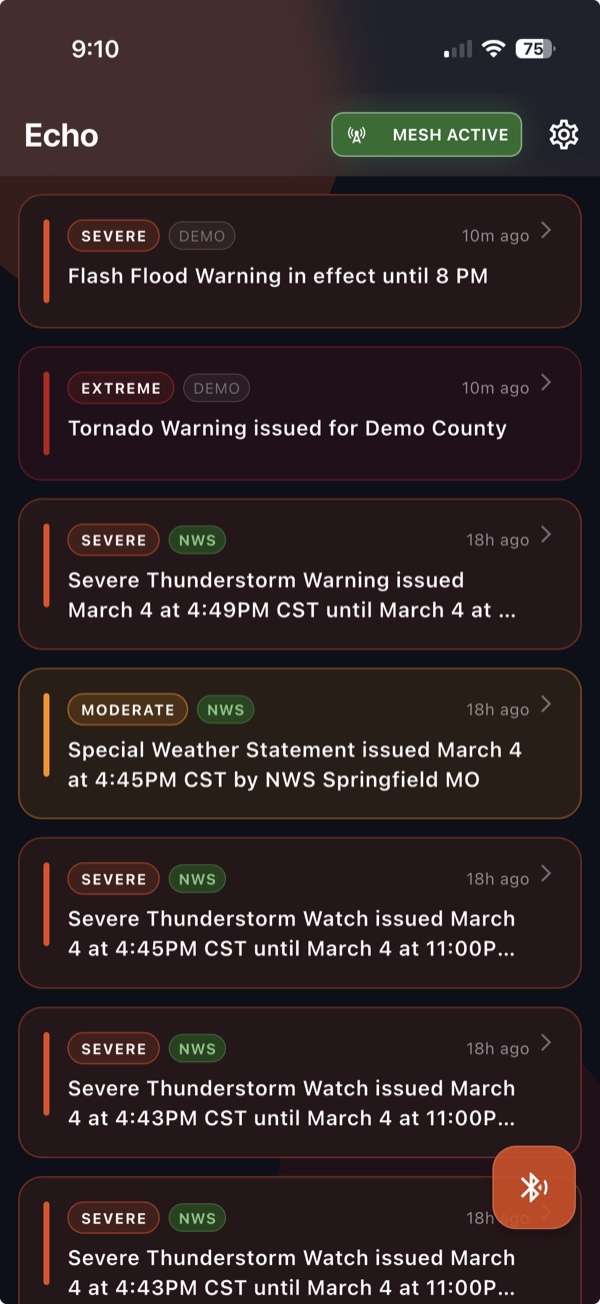
Emergency alerts depend on the same cellular and internet infrastructure that fails during the disasters they warn about. Echo carries National Weather Service alerts between nearby phones over Bluetooth Low Energy, with proximity in place of servers. Every phone both listens and broadcasts. We submitted it on Devpost as RE3, "Alert. Relay. Repeat."
What I built
I ported the project from native Kotlin to Flutter and built the BLE transport and chunking protocol, storage, the NWS feed, the background service, the Raspberry Pi relay and the documentation.
- Ported the app from native Kotlin to Flutter during the event, bridging native Kotlin and Swift GATT servers through platform channels so each phone is both BLE central and peripheral.
- Built the chunked, gzipped transfer protocol: one characteristic selects a chunk index, another returns it, and the receiver accepts gzip or raw UTF-8 so it reads the Python senders. Multi-hop relay increments a hop count, with compact alert IDs preventing loops.
- Built the background service (IPC asks the main engine to restart advertising), the NWS GeoJSON feed with a severity filter, SQLite storage, and on-device translation into 22 languages.
- Built a Raspberry Pi relay on BlueZ D-Bus with 9 passing unit tests, a desktop relay for macOS and Windows on bless, and a Streamlit UI.
Built with
Flutter, Dart, Kotlin, Swift, BLE / GATT, SQLite, BlueZ, Raspberry Pi
From the build